The Fabulous Lost & Found (Italian)
Italian
Peter Baynton
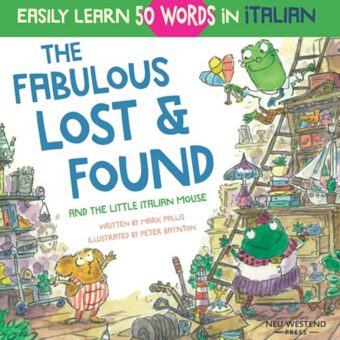
A little mouse walks into the Lost & Found, but can only speak Italian. How will Mr and Mrs Frog figure out what the mouse is missing…? Aimed at children aged 2-7, the unique ‘Story-powered language learning method’ combines humour, story and emotion to gently and memorably introduce kids to more than forty simple and fun Italian words and phrases. “The kids were so busy laughing they didn’t realise they were learning.” Kyle Buchannan, Dad of two, London. It’s a bilingual Italian English children’s book with a difference, that helps lay the foundations of a love of languages.
Reviews:
“I love that I can introduce my kids to a new language without it feeling like homework.” Zoe Reynolds, UK
“Let’s read it again.” Noah, aged 4.5
“Utterly charming story, making use of children’s natural approach to learning language” Madalena Xanthopoulou, We live Languages.
“A wonderful book to introduce a new language into the classroom.” Rohan Plunkett, Deputy Head, Akiva Primary School.
How does the Story Powered Language Learning Method work?
Unlike an Italian picture dictionary, traditional Italian books for kids, dual language bilingual Italian English books, Italian vocabulary book, or other Italian language learning book for kids, the Fabulous Lost and Found uses the ‘Story-powered Language Learning Method’ to teach children Italian by tapping into a child’s natural abilities. There are three steps:
We create an emotionally engaging and funny story for children and adults to enjoy together, just like any of the other Italian books for toddlers. Studies show that social interaction, like enjoying a book together, is critical in language learning.
Through the story, we introduce a relatable character who speaks only in the new language. This helps build empathy and a positive attitude towards people who speak different languages. These are both important aspects in laying the foundations for lasting language acquisition in a child’s life.
As the story in this Italian picture book progresses, the child naturally works with the characters to discover the meanings of a wide range of fun new words and phrases. Strategic use of humour ensures that this subconscious learning is rewarded with laughter; the child feels good and the first seeds of a lifelong love of language are sown.